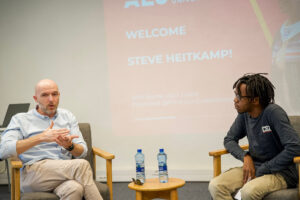
The conversation around infrastructure in Africa often centers on what’s missing, while overlooking what is already taking shape.
Across the continent, builders are starting anyway, working with limited systems, navigating constraints, and operating in real time. In this context, resourcefulness isn’t a workaround. It is part of the infrastructure itself.
At the African Leadership University (ALU), this is where the work begins. Through initiatives like Ventures Lab, students are testing what it takes to turn resourcefulness into viable ventures.
Beyond the Infrastructure Narrative
When innovation in Africa is discussed, infrastructure is often cast as the constraint, with the assumption that progress depends on systems being fully in place.
Yet across the continent, young people are building anyway, entering business and entrepreneurship at increasing rates, often without access to what is typically considered essential. Some are learning to code without consistent access to computers, while others are studying engineering in environments where electricity is unreliable. Progress is moving forward regardless of ideal conditions, and often in spite of them, forcing new ways of thinking, building, and creating.
Resourcefulness Is the Real Starting Point
What emerges from constraint is not just motion, but growth. Founders operating in these environments prioritize what works, focus on real problems, and iterate with precision, leaving less room for abstraction and more pressure to make ideas function in practice.
This is reflected in the pace of youth entrepreneurship across the continent. Global Entrepreneurship Monitor data shows that 52% of youth in Sub-Saharan Africa intend to start a business and 28% are already running one, making them among the most entrepreneurial globally. Builders are starting early, learning by doing, and developing solutions in real time.
In many cases, this creates a practical advantage. Innovators may not have full access to resources, but they are often closer to the problems they are solving. In this context, resourcefulness is not a workaround, but the starting point, shaping how ventures are built from day one and how they evolve as they grow.
Where Ideas Are Put to the Test: Ventures Lab
If resourcefulness is the starting point, the next question is what happens when it is supported.
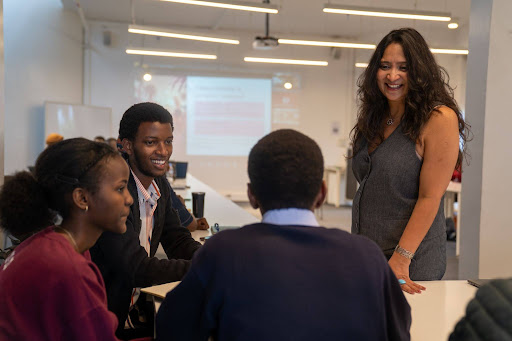
At ALU’s Centre for Entrepreneurship, Ventures Lab gives founders a place to bring what they have already begun, examine ideas closely, test their limits, and see what holds.
This year, 42 ventures across 10 sectors are part of the program, spanning early MVP, launch, and growth stages. Over 12 weeks, founders work to build traction, strengthen their business models, and become investment-ready, with top ventures eligible for up to $30,000 in non-dilutive funding.
Students build in response to what they have encountered. Ayomide Agbaje’s venture, Healthdrive, brings primary healthcare closer to rural and underserved communities. Afanfeoluwa Edon, founder of Dosteon, is building solutions that bring visibility into the food supply chain, helping businesses better manage their inventory and procurement processes.
In these cases and so many more, the starting point is proximity to the problem. The challenges are immediate, and the solutions reflect that, with initiatives like Ventures Lab helping them refine and strengthen their ideas.
Good Read: What ALU Students Are Building Across Africa
From Resourcefulness to Real Ventures
The most impactful builders do not wait for perfect systems. They start with what is available, shaping ideas in real time and learning through execution. That instinct is already present across the continent, and it is what ALU looks for from the beginning.
What matters next is how that instinct is supported. At ALU, resourcefulness is met with structure through deliberate systems designed to move ideas forward. Ventures Lab is one example. Founders arrive having already started and gain access to mentorship, funding, peer learning, and industry networks that sharpen direction and accelerate progress.
Over time, that support compounds. Early concepts become more defined, initial traction becomes more durable, and the distance between idea and scale begins to close.
Recommended Post: Learning Conservation at Laikipia