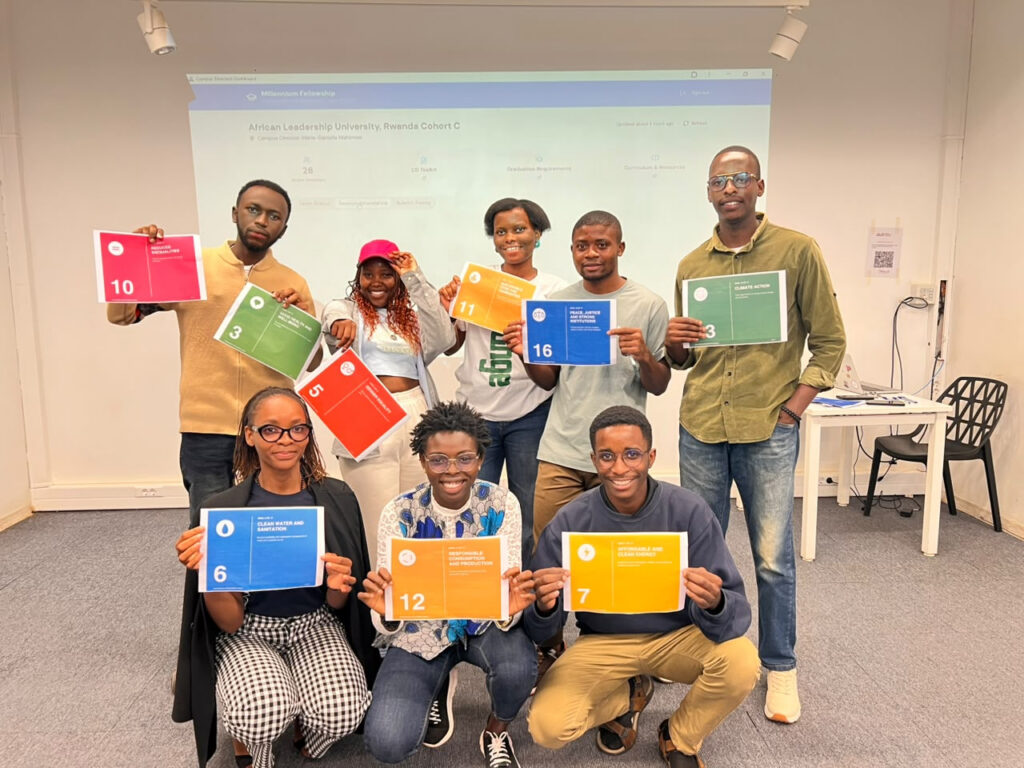
From improving healthcare access in Tanzania to tackling plastic pollution along Africa’s coastlines, 16 students from African Leadership University (ALU) and the African Leadership College of Higher Education (ALCHE) have been selected for the 2026 Millennium Fellowship.
Across Africa, some of the most pressing challenges facing communities are also shaping the ambitions of a new generation of university students. Whether addressing gaps in education, unemployment, environmental degradation, or access to healthcare, young people are increasingly looking for ways to contribute to solutions while pursuing their studies.
This year, 16 students from ALU and ALCHE have been selected for the Millennium Fellowship, a semester-long leadership development program organized by the Millennium Campus Network in partnership with United Nations Academic Impact.
The fellowship supports undergraduate students working to advance the United Nations Sustainable Development Goals (SDGs), providing opportunities for leadership development, collaboration, and community engagement.
For this year’s fellows, the program offers an opportunity to develop projects rooted in the challenges they have witnessed firsthand, and to explore what it takes to translate those experiences into meaningful, sustainable solutions.
What Does It Take to Turn an Idea Into a Solution?
For James Sanga, an ALCHE student from Tanzania, education has been instrumental in shaping his own opportunities. Now, through his initiative, WeAllCan Africa, he hopes to help secondary school students in underserved communities navigate their own educational journeys.
The project focuses on practical examination skills, mentorship, career guidance, and personal development, addressing gaps that can prevent students from reaching their potential even when they have access to formal schooling.
James hopes to use the fellowship to refine the program, develop learning resources, and establish partnerships that will allow it to reach more students.
His motivation is deeply personal.
“Being a Millennium Fellow means a lot to me because my own journey has been shaped by people and opportunities that believed in my potential before I fully saw it myself,” he explains.
For James, the fellowship is also an opportunity to reconsider what leadership means.
“Leadership is not about how far I go alone, but about how many people I can help move forward with me.”
His perspective raises an important question: how can universities help students move beyond identifying problems to developing the skills, relationships, and resources needed to address them?
Across the cohort, students are approaching that question from different directions. Laura Dorine Ishimwe is developing the NextGen Jobs Initiative to support youth employment in Rwanda, while Yom Deng Garang is working to expand equitable access to education in South Sudan.
At ALCHE, Grace Umwiza’s Bright Mind Rwanda focuses on mental health awareness among secondary school students, while Emmanuela Ugonma Nkwocha’s SEED Financing explores how digital skills and financial literacy can strengthen young people’s economic opportunities.
Although their projects differ, each begins with a particular barrier to opportunity and an attempt to understand how it might be addressed.
Why Listening Matters as Much as Innovation
Developing a solution requires more than recognizing a problem. It also means understanding the people affected, the systems already in place, and the practical constraints that can determine whether an intervention succeeds.
For Nairath Ngururu, an ALCHE student developing Rural-Afya Bridge, this means examining how rural communities in Tanzania access primary healthcare.
Her proposed initiative aims to strengthen connections between households, community health workers, and existing healthcare facilities through health education, early screening, referrals, and follow-up care.
In Ghana, ALU student Nuake Justice Tsekpo Junior is taking a similar community-centred approach to waste management.
His project, Sani-Link, proposes a WhatsApp-based reporting system that would allow residents to flag overflowing communal waste containers and improve coordination with waste collection services and local authorities.
The idea emerged from his experiences in Nima-Maamobi, where delays in waste collection can expose residents to unsanitary conditions.
Meanwhile, ALU student Rosanne Masugue Ngangoumoun is exploring the use of artificial intelligence and satellite imagery to identify plastic waste along coastlines through her project, OceaNova Action. Her proposed model also involves working with local fishermen to recover plastic and exploring ways to repurpose collected materials.
These projects demonstrate how technology, community participation, and existing local knowledge can work together. They also highlight the importance of testing assumptions before scaling a solution.
For student-led initiatives, the challenge is not simply to develop something new, but to establish whether it can respond effectively to the needs of the people it is intended to serve.
What Happens After the Fellowship?
For many of the 2026 fellows, the next stage will involve turning early concepts into practical programmes, testing prototypes, engaging partners, and measuring results.
ALU student Tsungirirai Machingura, for example, is developing Eco-Cycle Hub, which explores the use of computer vision and Edge AI to improve PET plastic recycling in Kigali. Through the fellowship, Tsungirirai hopes to test the technology while working with stakeholders across the recycling sector.
Other students are focused on establishing partnerships, strengthening programme delivery, or building the foundations for longer-term community engagement.
The fellowship offers a structured environment in which to develop these approaches, but the question of sustainability will remain important beyond the programme itself.
How can a promising pilot become a reliable service? What makes a community initiative financially and operationally viable? And how can students build organisations that continue to serve people after their initial period of support ends?
These are questions that extend well beyond any single fellowship. They speak to the role universities can play in preparing students not only to enter the workforce, but also to understand complex problems, work across disciplines, and contribute to the development of their communities.
For the 16 ALU and ALCHE students selected this year, the Millennium Fellowship represents an opportunity to explore those questions through their own work.
Their projects are at different stages, and their long-term outcomes are still to be determined. What unites them is a willingness to engage with difficult challenges and begin the sustained work of finding solutions.